Thursday, July 9, 2015

Jesus Looked Nothing Like the Paintings


Given that his light eyes, sharp facial features and long hair (straight from a modern-day conditioner and shampoo advert) are so instantly recognizable, more than half the world identifies Jesus Christ.

As you can probably guess, Yeshua of Nazareth, the man Christians think of as “Jesus Christ” today, actually looked a lot more Middle Eastern seeing as he was… well… actually Middle Eastern.

Most scholastic texts agree that Jesus was like a ‘common man’, a fellow ‘brother’ to the mankind. Sure, he was the divine one, the chosen one, but he was also someone who led by example. And to be that, he needed to be ‘human’ and not look like someone concocted with magical potions of good looks and Caucasian skin color (something which was pretty synonymous with supposed racial supremacy for the Western world).

Why We Picture it Wrong:
For the dominant image of Jesus as a whitey, blame those Renaissance era master artists – Da Vinci, Raphael, Michelangelo and his ilk.

True to their artistic loyalties, they painted him like a handsome Greek or Italian man. It helped that it became easily identifiable for followers of Christianity in Europe. In the age of the Crusades, the Church was better off not reminding people they were praying to a little, brown Jew.

Similarly, many African and Arab Christians painted Jesus with dark skin and bushy mop, or painters from Far East or Hispanic regions added local racial features – something which immediately invokes easier association.

Worldly Bondages And Salvation


Because of the eight types of bondages which a man feels on this earth, the soul is also known as "Jiva". The Jiva becomes liberated only after becoming free from these eight bondages.

These eight bondages are -
1. Nature
2. Intelligence
3. Ego
       and Panchatanmatras i.e.
4. Sound
5. Touch
6. Appearance
7. Taste
8. Smell.

"Each soul is binded by these eight aspects of the Nature. The actions performed as the result of these bondages is called Karma.A man reaps the fruits of his actions- whether good or evil. He either enjoys pleasures or suffers because of sorrow, due to this Karma."

The soul takes rebirth in a cyclic was binded by the effects of his Karmas. The eight Chakra' are nothing but the eight forms of the nature. Shiva is beyond the reach of these eight chakras, on the contrary he has full control these eight chakras.

--ShivMahapuran

Tuesday, July 7, 2015

The Essence Of Yoga (योग)


Yoga means union with God. The state of yoga is impossible to attain without the blessings of Lord Shiva. It needs a concentrated and focussed mind. There are some specific spots in the human body concentrating upon which, enables a man to attain the state of yoga-spot between the eyebrows, lower part of the throat, navel etc.

The state of yoga can never be attained until and unless a person has fully controlled the tendencies of sense organs. It can be achieved with the help of eight means-
१. Yama (penance)
२. Niyam (discipline)
३. Asan (posture)
४. Pranayama (breath-control)
५. Pratyahar (restraint of passion)
६. Dharan (retention)
७. Dhyan (concentration)
८. Samadhi (deep meditation)

Each of them holds an important position in the path of yoga.
A person should sit with his legs crossed in Padmasan and try to concentrate his mind by fixing his gaze between his eyebrows. He should keep his spine erect. He should meditate either on the form of Omkar or on the form of lord Shiva.

Breath control is an important aspect of yogic exercise. A man should exhale deeply for 32 times and then breathe in deeply. He should then retain his breath as long as possible and visualize lord Shiva within his body. By constant practice he will achieve mastery over this art and a time will come when he will experience divine bliss. This divine bliss can not be experienced unless one has attained a deep state of meditation (Samadhi).

Obstacles in the path of Yoga:
A man experiences numerous obstacles in the path of Yoga-laziness, restlessness confusion, a diseased body etc. The main reason for being lazy is a bulky physique and one's inability to concentrate his mind. Lack of concentration results in restlessness, which is a major obstacle in the path of yoga. If a person in unsure about the results he becomes confused. It is impossible for a person suffering from any disease to concentrate his mind.

All the above mentioned hurdles can be overcome by firm resolution. A man who has successfully overcome all these obstacles might experience other obstacles in the form of siddhis (divine powers). There is a real danger of getting lured by these divine powers. As a result his mind may get distracted from his original goal and he may deviate from his path.

The names of these siddhis or divine powers are:
१. Pratibha (having knowledge of past present and future incident)
२. Shravana (being capable of listening to abnormal sounds)
३. Varta (whatever is said becomes true)
४. Darshana (capable of seeing things which can mot be seen by the mortal eyes)
५. Aswada (being capable of experiencing divine (tastes)
६. Vedana (being capable of relieving other's pain by a mere touch)

If a person successfully overcomes all these allurements then he becomes a siddha- or man of accomplishment and divine powers.


source: लिंगपुराण

Sunday, July 5, 2015

Vedic Roots of Yazidis


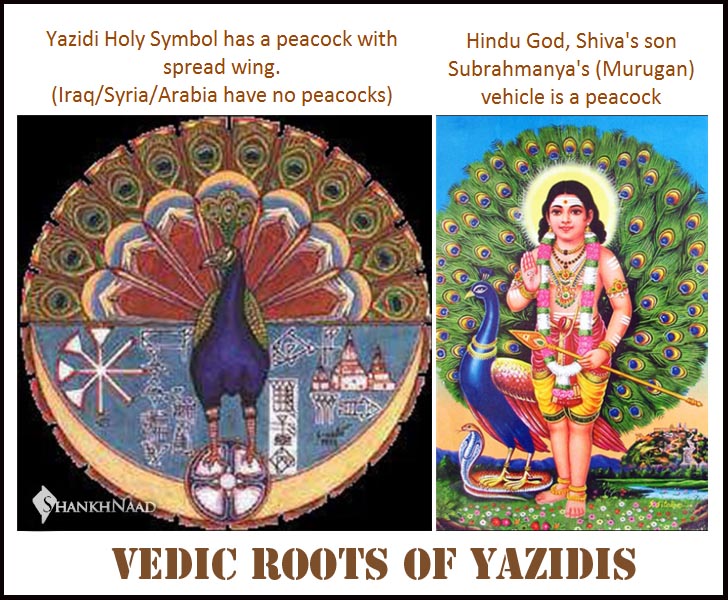
The Yezidis are a very ancient people from Iraq with their calender being 6764 yrs old. About 5000 years ago Yezidis migrated from India to Afganistan, Iran, Iraq and middle east. At that time they were called children of Melek Taus same as Murugan, a God found in south of India.

The religion of Yezidis share much in common with Vedic Hindus. Yezidis believe in reincarnation. Peacock finds a special place, which is worshiped as Melek taus/Murugan. No  peacock is found in Iraq or the middle east but is native to India. The language in which the Yezidi holy books are written is Avesta which is thought to be same language of Sanskrit. Lord Rama is also one of the Yezidi Gods. The temple tops of the Yezidis look much like the Hindu temples. The serpent is the totem of Melek Taus/Murugan and symbolizes the Kundalini released.

Even with all of their ostensible connections to other faiths, the Yezidis have for hundreds of years been under constant attack from Moslems who promulgate the idea that the Yezidi’s principle diety, Tawsy Melek, the “Peacock Angel”, is Satan. Moslems also contend that the Yezidis are not “People of the Book”, i.e., that they don’t have a sacred revealed scripture like the Holy Bible or the Koran at the center of their religion, so they claim justification in their massacre of them.

Or even worse, some Moslems have pronounced the Yezidis as heretics who were once orthodox Moslems – an allegation that puts them in the lowest rung of humanity. Over the course of 700 years, nearly 23 million Yezidi people have been murdered, thus bringing their civilization to the brink of extinction.


Saturday, July 4, 2015

Islamic state destroys The Lion of Al-Lat - discovered at a temple of a pre-Islamic goddess


Islamic State group militants destroyed a famous statue of a lion outside the main museum in the ancient Syrian city of Palmyra

The statue, known as the Lion of Al-Lat, was an irreplacable piece and was apparently destroyed. "IS members destroyed the Lion of al-Lat, which is a unique piece that is three metres (10 feet) tall and weighs 15 tonnes," Abdelkarim told AFP. "It's the most serious crime they have committed against Palmyra's heritage," he said. The limestone statue was discovered in 1977 by a Polish archeological mission at the temple of Al-Lat, a pre-Islamic Arabian goddess, and dated back to the 1st century BC.

the statue had been covered with a metal plate and sandbags to protect it from fighting "but we never imagined that IS would come to the town to destroy it." IS captured Palmyra, a renowned UNESCO World Heritage site, from government forces, prompting international concerns about the fate of the city's antiquities.

Abdelkarim said the busts "appear to be eight statues stolen from the tombs in Palmyra." "The destruction is worse than the theft because they cannot be recovered." IS's harsh version of Islam considers statues and grave markers to be idolatry, and therefore against their religion, and the group have destroyed antiquities and heritage sites in territory under its control in both Syria and Iraq.

Allāt or al-Lāt (Arabic: اللات‎) was a Pre-Islamic Arabian goddess who was one of the three chief goddesses of Mecca along with Manāt and al-‘Uzzá.

The shrine and temple dedicated to al-Lat in Taif was demolished on the orders of Muhammad, during the Expedition of Abu Sufyan ibn Harb, in the same year as the Battle of Tabuk(which occurred in October 630 AD).The destruction of the idol was a demand by Muhammad before he would allow any reconciliation to take place with the tribes of Taif, who were under his siege.

Friday, July 3, 2015

Renowned Thinkers Who Appreciated the Vedic Literatures


Many of the worlds greatest thinkers admired the Vedas as great repositories of advanced knowledge and high thinking


Arthur Schopenhauer, the famed German philosopher and writer, wrote that: I "...encounter [in the Vedas] deep, original, lofty thoughts... suffused with a high and holy seriousness."

The well-known early American writer Ralph Waldo Emerson, read the Vedas daily. Emerson wrote: "I owed a magnificent day to the Bhagavat-Gita"

Henry David Thoreau said: "In the morning I bathe my intellect in the stupendous philosophy of the Bhagavad Gita... in comparison with which... our modern world and its literature seems puny and trivial."

So great were Emerson and Thoreau's appreciation of Vedantic literatures that they became known as the American transcendentalists. Their writings contain many thoughts from Vedic Philosophy.

Other famous personalities who spoke of the greatness of the Vedas were: Alfred North Whitehead (British mathematician, logician and philosopher), who stated that: "Vedanta is the most impressive metaphysics the human mind has conceived."

Julius Robert Oppenheimer, the principle developer of the atomic bomb, stated that "The Vedas are the greatest privilege of this century." During the explosion of the first atomic bomb, Oppenheimer quoted several Bhagavad-gita verses from the 11th chapter, such as: "Death I am, cause of destruction of the worlds..."

When Oppenheimer was asked if this is the first nuclear explosion, he significantly replied: "Yes, in modern times," implying that ancient nuclear explosions may have previously occurred.


Lin Yutang, Chinese scholar and author, wrote that: "India was China's teacher in trigonometry, quadratic equations, grammar, phonetics... " and so forth.

Francois Voltaire stated: "... everything has come down to us from the banks of the Ganges."

French astronomer Jean-Claude Bailly corroborated the antiquity and accuracy of the Vedic astronomical measurements as "more ancient than those of the Greeks or Egyptians." And that, "the movements of the stars calculated 4,500 years ago, does not differ by a minute from the tables of today."


From these statements we see that many renowned intellectuals believed that the Vedas provided the origin of scientific thought.

Thursday, July 2, 2015

Jagannath Temple at Comilla,Bangladesh


In the Comilla district of Bangladesh is an ancient temple of Lord Jagannath.

Comilla Jagannath Temple, also known as Saptaratna ('seven jewels') Mandir, is dedicated to the worship of Lord Jagannath. The temple was built in the 16th Century by Sree Sreejoktou Moharaja Rada Kishor Manikuo Bahadur, the King of Tripura. This is one of the oldest temples in Comilla, which is located in eastern Bangladesh along the Dhaka-Chittagong Highway. Comilla is one of the three oldest cities in Bangladesh. The temple complex resides on the southeast sides of Comilla City (also known as Kandirpar) at Jagannathpur village, five kilometers east of the city on the Comilla-Bibir Bazar Road.

The exact time of construction is not known, but the temple is generally dated by its terracotta architecture. At the time of King Badhadur's reign, Comilla was known as Tippera (or Tripura).

The princely State of Tripura, including all of the Comilla region, was ruled by the Deva dynasty in the 8th Century, then came under the reign of the kings of the Harikela in the 9th Century. It came under the rule of East India Company in 1765.

Tripura, an ancient seat of Vaisnavism, was bordered by Bangladesh to the north, south, and west, with Assam and Mizoram to its east. Tripura is mentioned in many Vedic texts, including the Mahabharata and Puranas. It's also mentioned in the Edicts of Ashoka, stone pillar inscriptions from the 3rd Century B.C. In ancient times, Tripura was known as Kirat Desh ("The land of Kirat").

There seems to be little information available about the Deities of this temple, except that Lord Jagannath, Balabhadra and Subhadra were originally installed in another temple located in 'hilly Tripura'. Once the new temple construction was completed, Their Lordships were moved and installed at Their new Comilla abode.

The architecture of Lord Jagannatha's Temple at Comilla is striking and beautiful, as seen in the circa 1843 sketch above, and current photographs. The temple is approx. 60 feet tall, being a four-storied conical shape built of brick on an octagonal base-stone. This is said to be the only octagonal shaped temple of its time in Bangladesh.

The temple is ornamented with various terracotta designs like flowers, leaves, etc. The Department of Archaeology renovated portions of the outer ground and first floors, and apparently some of the terracotta did not survive the process.